
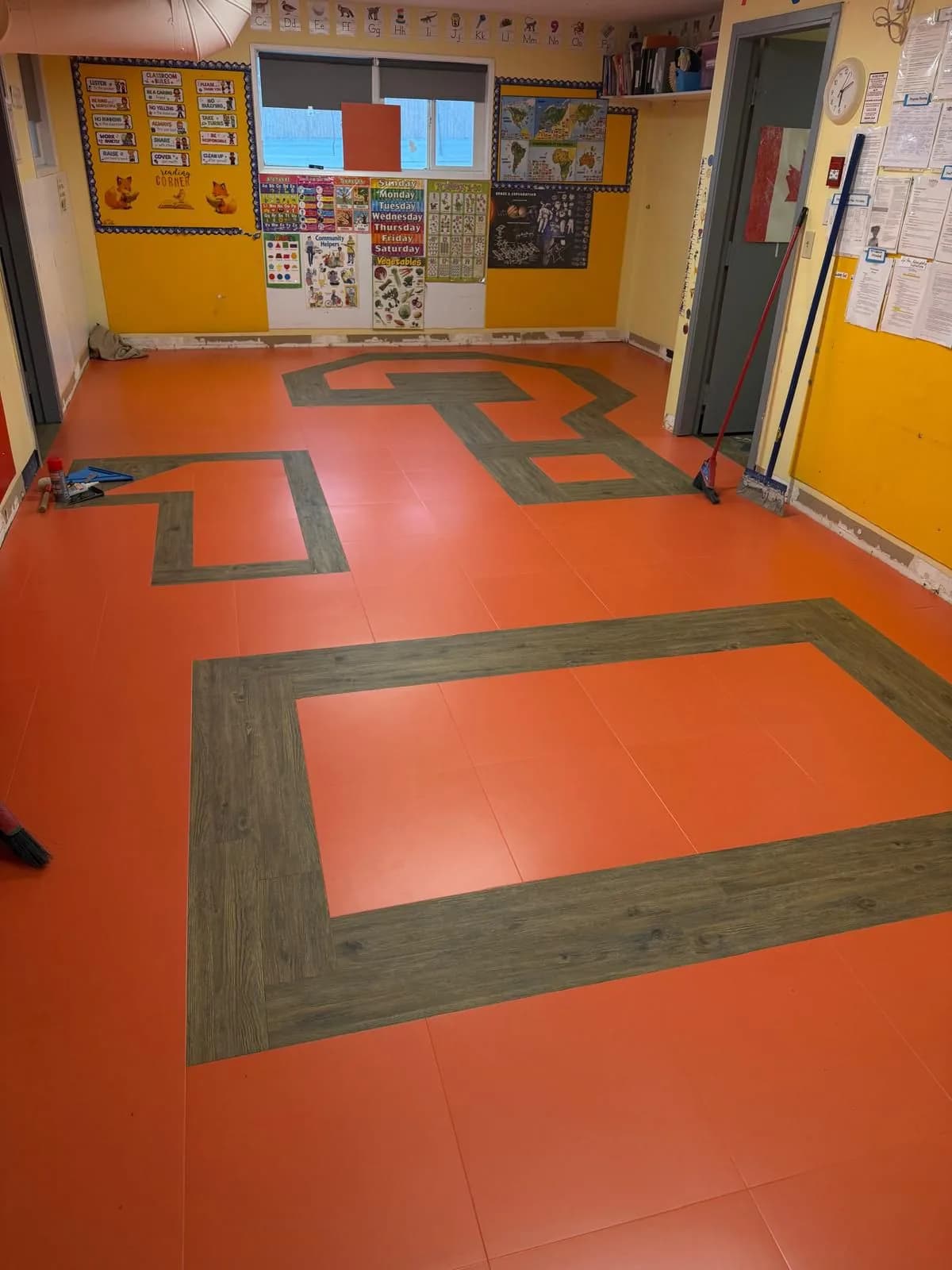
Glue Down Vinyl vs Click Vinyl Flooring
Glue down vinyl vs click vinyl flooring is an important comparison for homeowners, contractors and property managers planning a new flooring installation. Both systems can provide a durable and modern finish, but they differ in installation method, subfloor requirements, repair process and long-term performance.
The right choice depends on the size of the project, condition of the subfloor, expected traffic and how the space will be used. FlooringDNA installs both systems for residential, commercial and multi-family projects across Calgary. Learn more about our vinyl flooring services.
What Is Glue Down Vinyl Flooring?
Glue down vinyl is installed directly onto the prepared subfloor using a flooring adhesive. Each plank or tile is placed individually and pressed into position.
This method creates a low-profile and stable finished surface. It is commonly used in commercial properties, apartment projects, offices, retail spaces and high-traffic areas where long-term stability is important.
Common advantages include:
Strong bond to the subfloor
Stable performance in large areas
Low finished floor height
Easier replacement of individual planks
Suitable for heavy traffic
Clean transitions between rooms
Because the material follows the condition of the subfloor closely, proper preparation is essential.
What Is Click Vinyl Flooring?
Click vinyl flooring uses a locking system that connects each plank without adhesive. The floor floats over the subfloor and is usually installed with an expansion gap around the perimeter.
Click vinyl is widely used in houses, condos, basements and renovation projects because installation is often faster and less disruptive than glue down systems.
Common advantages include:
Faster installation
No flooring adhesive
Comfortable walking surface
Suitable for many residential spaces
Easy installation over prepared subfloors
Wide range of styles and thicknesses
The locking system must be handled carefully during installation to avoid damaged edges or weak connections.
Installation Method
The main difference between glue down and click vinyl is how the flooring is attached.
Glue down vinyl is bonded directly to the subfloor. The installer applies adhesive, allows the correct working time and places each plank into position.
Click vinyl is assembled plank by plank using the locking edges. The finished floor remains separate from the subfloor and expands or contracts as a complete system.
Glue down installation generally requires more preparation and attention to adhesive conditions. Click installation may be faster, but layout, expansion spacing and locking integrity still require professional planning.
Subfloor Preparation
Both flooring systems require a clean, stable and properly prepared subfloor.
For glue down vinyl, small imperfections can become visible through the material. Uneven areas, adhesive residue, cracks and surface contamination must be corrected before installation.
Click vinyl can tolerate minor surface variation depending on the product, but it should not be installed over damaged or excessively uneven floors.
Subfloor preparation may include:
Removing old flooring
Scraping adhesive
Repairing cracks
Applying patching products
Self-leveling low areas
Cleaning dust and debris
Inspecting moisture conditions
Skipping these steps can cause visible imperfections, movement, noise or premature flooring failure.
Durability and Traffic
Glue down vinyl is often selected for high-traffic environments because the planks remain bonded to the floor. This stability can be useful in commercial spaces, hallways and multi-family buildings.
Click vinyl also performs well when the correct product is selected. Residential-grade and commercial-grade options are available with different wear layers and locking systems.
Durability depends on more than installation type. Product quality, wear layer, maintenance and subfloor condition all influence long-term performance.
Repair and Replacement
Glue down vinyl can be practical when individual planks need replacement. A damaged plank can often be removed and replaced without taking apart a large section of the floor.
Click vinyl repairs may require disconnecting several rows of flooring to reach the damaged area. In some cases, an individual plank can be cut out and replaced, but the process is usually more complex.
For properties where isolated damage is more likely, glue down vinyl may offer an advantage.
Moisture and Basement Use
Both systems can be suitable for basement installations when the concrete slab is dry, stable and properly evaluated.
Click vinyl is common in finished basements because it creates a floating surface and can provide a slightly softer feel underfoot.
Glue down vinyl may also be used over concrete, but moisture conditions and adhesive compatibility must be checked carefully before installation.
No vinyl system should be installed over active moisture problems. The source of the issue should be addressed first.
Floor Height and Transitions
Glue down vinyl is generally thinner than click vinyl. This can help when matching existing floor heights or creating smoother transitions between rooms.
Click vinyl is usually thicker because of its rigid core and locking system. Door clearances, transitions and stair connections should be reviewed before installation begins.
Floor height is especially important in renovation projects where several different flooring materials meet.
Commercial and Multi-Family Projects
Glue down vinyl is frequently used in commercial and multi-family construction because it performs well across large areas and allows easier individual plank replacement.
Click vinyl can also be suitable for apartments, offices and smaller commercial spaces, depending on product specifications and traffic expectations.
For larger projects, the installation method should be selected based on maintenance requirements, schedule, floor condition and long-term use rather than appearance alone.
Which Vinyl Flooring Is Better?
There is no single best option for every project.
Glue down vinyl may be better when:
The space receives heavy traffic
Low floor height is important
Individual plank replacement matters
The project covers a large commercial area
Maximum floor stability is required
Click vinyl may be better when:
Faster installation is preferred
The project is residential
A floating floor system is suitable
The subfloor is properly prepared
Comfort underfoot is a priority
The correct choice should be based on the project conditions rather than the installation method alone.
Professional Vinyl Flooring Installation in Calgary
Choosing between glue down vinyl and click vinyl flooring requires a clear understanding of the subfloor, traffic level, floor height and maintenance expectations.
FlooringDNA provides demolition, floor preparation, repairs and professional installation for both systems. View examples of our work on the Calgary flooring projects page.
To discuss your project, contact FlooringDNA or use our square footage calculator before requesting an estimate.
FlooringDNA · Calgary
Planning a flooring project?
Get a free estimate for your flooring project in Calgary.
About
FlooringDNA
Since 2016, FlooringDNA has delivered luxury vinyl plank (LVP), tile installation and flooring solutions for projects of every size across Calgary.
More articles